
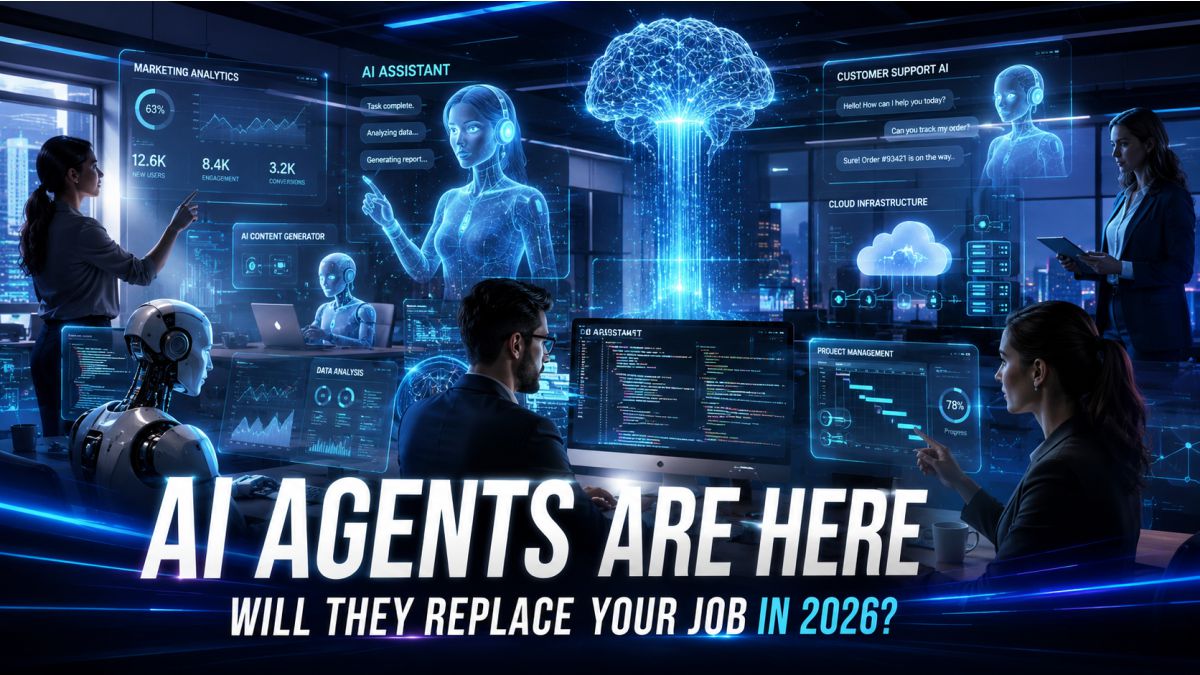
AI Agents Are Here: Will They Replace Your Job in 2026?
Artificial Intelligence has entered a completely new era. Instead of simply answering questions or generating content, modern AI systems are becoming autonomous AI agents capable of planning tasks, making decisions, using external tools, browsing the web, writing code, analyzing data, and even collaborating with humans.
The biggest question in 2026 isn't whether AI is becoming smarter—it's whether AI agents will replace millions of jobs.
The answer is more complex than a simple yes or no.
What Are AI Agents?
Traditional AI chatbots wait for users to ask questions.
AI agents, on the other hand, can:
-
Plan multi-step tasks
-
Make decisions automatically
-
Use software tools
-
Search the web
-
Write and debug code
-
Generate reports
-
Manage projects
-
Interact with APIs
-
Learn from previous tasks
Instead of acting like a chatbot, an AI agent behaves more like a digital employee.
Why AI Agents Are Growing So Fast
Several major technology companies and AI startups are investing billions into autonomous agents.
Some of the biggest names include:
-
Grok
-
Claude
-
ChatGPT Agents
-
Open-source AI agent frameworks
-
Enterprise automation platforms
These systems are designed to complete entire workflows instead of individual prompts.
For businesses, this means lower operational costs, faster execution, and 24/7 productivity.
Industries Already Being Transformed
Software Engineering
AI agents can now:
-
Generate production-ready code
-
Review pull requests
-
Detect bugs
-
Write documentation
-
Create APIs
-
Perform automated testing
Rather than replacing software engineers entirely, AI is increasing developer productivity by handling repetitive tasks.
Developers who understand AI-assisted programming are becoming significantly more efficient.
Digital Marketing
Marketing teams are using AI agents for:
-
SEO optimization
-
Keyword research
-
Blog writing
-
Email campaigns
-
Ad copy creation
-
Competitor analysis
-
Social media scheduling
-
Performance reporting
Many tasks that once required several employees can now be completed by a small team working alongside AI.
Customer Support
Customer service is one of the fastest-changing industries.
Modern AI agents can:
-
Answer customer questions
-
Process refunds
-
Handle bookings
-
Troubleshoot technical issues
-
Route complex requests
-
Provide multilingual support
Human agents are increasingly focusing only on difficult or emotional conversations.
Content Creation
AI agents can produce:
-
Articles
-
Product descriptions
-
Social media posts
-
Video scripts
-
Presentation outlines
-
Marketing campaigns
Human creativity remains valuable, but AI dramatically speeds up production.
Jobs Most Likely to Change
The roles most affected include:
-
Customer Support Representatives
-
Data Entry Operators
-
Junior Content Writers
-
Virtual Assistants
-
Administrative Staff
-
Basic Research Analysts
-
Simple Graphic Production
-
Entry-Level Marketing Roles
These positions involve repetitive digital work that AI can increasingly automate.
Jobs That Will Continue to Grow
While some roles may shrink, others are expanding rapidly.
High-demand careers include:
-
AI Engineers
-
Prompt Engineers
-
AI Product Managers
-
Automation Specialists
-
Cybersecurity Experts
-
Machine Learning Engineers
-
AI Integration Consultants
-
Data Scientists
-
AI Trainers
-
Human-AI Workflow Designers
Professionals who know how to collaborate with AI will likely see greater opportunities.
AI Will Replace Tasks More Than Entire Jobs
One common misconception is that AI will eliminate every profession.
In reality, AI is more likely to replace specific tasks within a job rather than the entire role.
For example:
A marketing manager may no longer spend hours writing first drafts because AI can generate them in minutes. Instead, the manager focuses on strategy, brand voice, and campaign planning.
Similarly, software developers spend less time writing repetitive code and more time solving complex problems.
Skills You Should Learn in 2026
To remain competitive, professionals should develop skills such as:
-
AI Prompt Engineering
-
Workflow Automation
-
Data Analysis
-
Critical Thinking
-
Communication
-
AI Tool Integration
-
Python Programming
-
Cybersecurity Basics
-
Cloud Computing
-
Business Strategy
Learning how to manage AI is becoming just as important as learning traditional software tools.
Challenges of AI Agents
Despite their impressive capabilities, AI agents still face limitations.
Some common challenges include:
-
Hallucinated information
-
Privacy concerns
-
Security risks
-
Compliance issues
-
High computing costs
-
Ethical decision-making
-
Limited reasoning in complex situations
Human supervision remains essential for critical business operations.
The Future of Work
Experts increasingly believe that the workplace will become a collaboration between humans and AI rather than a competition.
Companies will likely hire people who can effectively supervise, manage, and improve AI systems instead of performing every task manually.
The workforce of the future will be smaller, more specialized, and heavily supported by intelligent automation.
Final Thoughts
AI agents are no longer experimental technology—they are becoming an essential part of modern business.
Will AI replace jobs?
Some routine roles will undoubtedly change or disappear. However, history shows that technological revolutions also create entirely new industries and career opportunities.
The professionals who continuously learn, adapt, and embrace AI will be in the strongest position over the coming years.
Rather than asking whether AI agents will replace your job, the better question is:
How can you use AI agents to become more valuable in your career?

Reader Discussions
No comments posted yet. Be the first to start the discussion!
Leave a Reply