
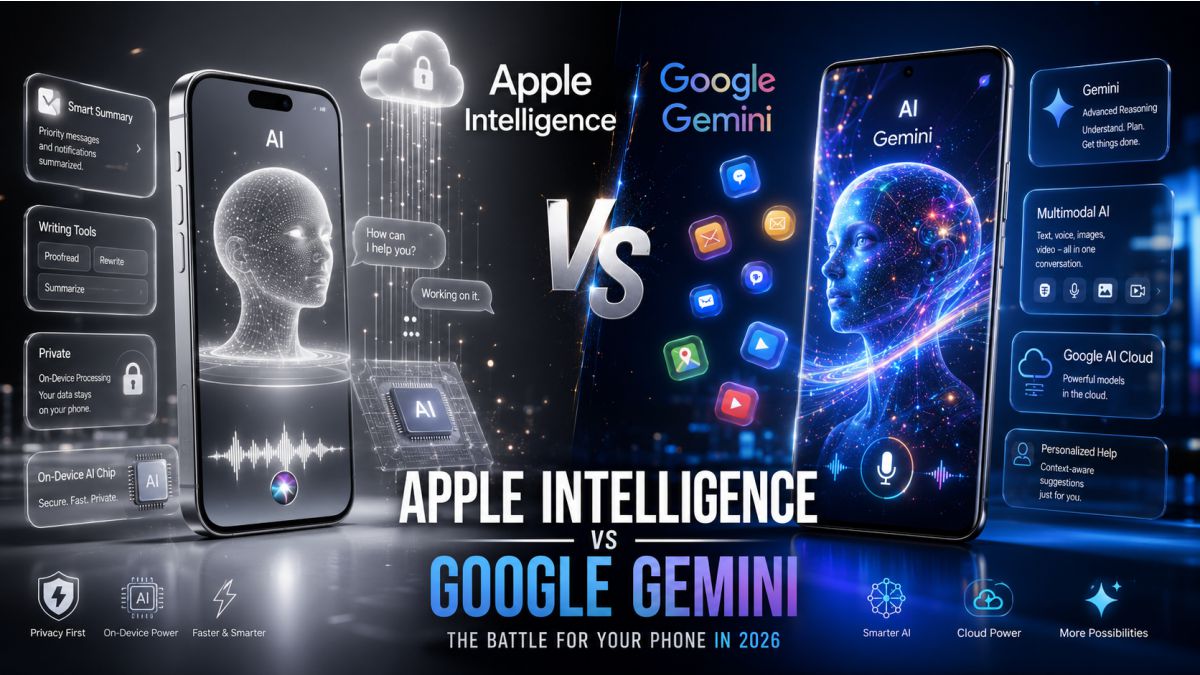
Apple Intelligence vs Google Gemini: The Battle for Your Phone in 2026
Artificial Intelligence has become the biggest selling point for modern smartphones. In 2026, the competition is no longer just about faster processors, better cameras, or brighter displays—it's about which AI assistant can make your phone smarter, faster, and more helpful.
Apple Intelligence and Google Gemini represent two different visions of mobile AI. While Apple emphasizes privacy and on-device intelligence, Google focuses on powerful cloud AI, deep integration with its services, and advanced multimodal capabilities.
So which ecosystem is winning the AI race in 2026?
Let's compare them feature by feature.
What Is Apple Intelligence?
Apple Intelligence is Apple's personal AI system built into iPhone, iPad, and Mac devices.
Rather than acting as a standalone chatbot, it works across apps and the operating system to help users write, summarize, organize, edit photos, create images, and complete everyday tasks.
Apple combines on-device AI with secure cloud processing for more demanding requests, aiming to balance performance with user privacy.
What Is Google Gemini?
Google Gemini is Google's AI platform integrated across Android smartphones, Pixel devices, Chrome, Gmail, Google Docs, Maps, Photos, Workspace, and Search.
Gemini functions as both a conversational AI assistant and a powerful productivity tool capable of understanding text, images, voice, videos, and documents.
Its deep connection to Google's ecosystem makes it one of the most capable AI assistants available.
On-Device AI Performance
One of the biggest trends in 2026 is running AI directly on the phone.
Apple Intelligence
Apple processes many everyday AI tasks directly on compatible devices using its custom Apple Silicon chips.
Benefits include:
- Faster responses
- Better privacy
- Offline functionality for supported features
- Lower latency
- Reduced cloud dependency
Google Gemini
Google increasingly supports on-device AI through Tensor-powered Pixel phones and newer Android hardware.
Depending on the feature, Gemini can process tasks locally or use Google's cloud AI for more advanced reasoning and larger models.
This hybrid approach provides flexibility while maintaining access to Google's powerful AI infrastructure.
Privacy Comparison
Privacy remains one of the biggest differences between the two ecosystems.
Apple's Approach
Apple promotes a privacy-first design.
Key highlights include:
- Extensive on-device processing
- Minimal data collection
- Secure cloud processing for complex tasks
- User-focused privacy controls
- Strong encryption across devices
For users who prioritize personal privacy, Apple's approach is a major advantage.
Google's Approach
Google has significantly improved privacy controls while continuing to leverage cloud intelligence.
Advantages include:
- Personalized AI experiences
- Context-aware recommendations
- Integration across Google services
- Advanced search capabilities
- Flexible account controls
Because Gemini relies more heavily on Google's connected ecosystem, users benefit from richer personalization but may share more data to enable those features.
Writing and Productivity Features
Both platforms include AI-powered writing tools.
Apple Intelligence
- Rewrite text
- Proofreading
- Tone adjustments
- Email summaries
- Notification summaries
- Smart replies
- Image generation in supported apps
Google Gemini
- Long-form writing
- Email drafting
- Document summarization
- Spreadsheet assistance
- Presentation generation
- Workspace integration
- Advanced research assistance
Google currently offers broader productivity integration, especially for users who rely on Gmail, Docs, Sheets, and Drive.
Voice Assistant Comparison
Voice assistants have become significantly smarter.
Apple
Siri has become more context-aware with Apple Intelligence, allowing it to better understand conversations, perform actions across apps, and maintain context between requests.
Gemini delivers more conversational interactions, advanced reasoning, and deeper integration with Google Search, Maps, Calendar, and Workspace.
For users who depend on Google's ecosystem, Gemini often provides more comprehensive assistance.
Photo and Image AI
AI photography continues to improve every year.
Apple Intelligence
Features include:
- Object removal
- Smart photo search
- Automatic image organization
- AI editing tools
- Memory creation
- Natural language photo search
Google Gemini
Google continues to lead in computational photography with features like:
- AI photo editing
- Magic editing tools
- Intelligent image search
- Video enhancements
- Scene understanding
- Context-aware editing
Ecosystem Integration
This is where the two companies differ the most.
Apple Ecosystem
Apple Intelligence works seamlessly across:
- iPhone
- iPad
- Mac
- Apple Watch
- AirPods
- Messages
- Notes
- Safari
- Photos
Users who already own multiple Apple devices enjoy a smooth and consistent experience.
Google Ecosystem
Gemini integrates with:
- Android phones
- Pixel devices
- Chrome
- Gmail
- Google Docs
- Google Sheets
- Google Drive
- Google Photos
- Maps
- Calendar
- YouTube
Android users benefit from Google's broad range of connected services and cross-platform availability.
Which AI Is Better?
Choose Apple Intelligence if you:
- Value privacy above everything
- Own multiple Apple devices
- Prefer on-device processing
- Want seamless ecosystem integration
- Use Apple apps daily
Choose Google Gemini if you:
- Use Android devices
- Depend on Gmail and Google Workspace
- Need advanced AI research
- Prefer powerful cloud-based AI
- Want broader productivity features
The Future of Smartphone AI
The competition between Apple and Google is accelerating innovation across the smartphone industry.
Future developments are expected to include:
- Smarter voice assistants
- More capable on-device AI
- Better image generation
- Real-time language translation
- Autonomous task automation
- Personalized AI agents
- Cross-device intelligence
As AI hardware becomes more powerful, many advanced features that currently require cloud computing may eventually run entirely on-device.
Final Verdict
Apple Intelligence and Google Gemini represent two outstanding approaches to mobile AI.
Apple focuses on privacy, seamless hardware integration, and efficient on-device intelligence. Google emphasizes flexibility, cloud-powered reasoning, and deep productivity integration.
Neither platform is objectively better for everyone.
If you're deeply invested in the Apple ecosystem and value privacy, Apple Intelligence is an excellent choice.
If you rely on Google's services, want cutting-edge AI capabilities, and prefer Android's flexibility, Google Gemini remains one of the most powerful mobile AI platforms available.
Ultimately, the winner in 2026 depends less on the AI itself and more on which ecosystem best fits your daily life.

Reader Discussions
No comments posted yet. Be the first to start the discussion!
Leave a Reply